What an Indiana Home Inspection Covers and Leaves Out
Realest, Northwest Indiana, buying a home
An Indiana home inspection is a visual check of a house's major systems by a licensed home inspector, and state law requires the written report to say what it does not cover. Radon, lead-based paint, mold, termites and other wood-destroying insects, sewer lines, septic systems, wells and fuel tanks all sit outside a standard report. If any of those matter for the house you're buying, book a separate test or inspection and fit it inside the inspection period in your purchase agreement.
Prepared by Sash Joveski of Realest. Research checked November 12, 2026, against Indiana Code 25-20.2, the state home inspection standards in 878 IAC 1-2-1, the Indiana Department of Health, the U.S. EPA and the Lake County and Porter County health departments. This is general information for buyers in Northwest Indiana, not legal advice.


What an Indiana home inspection covers
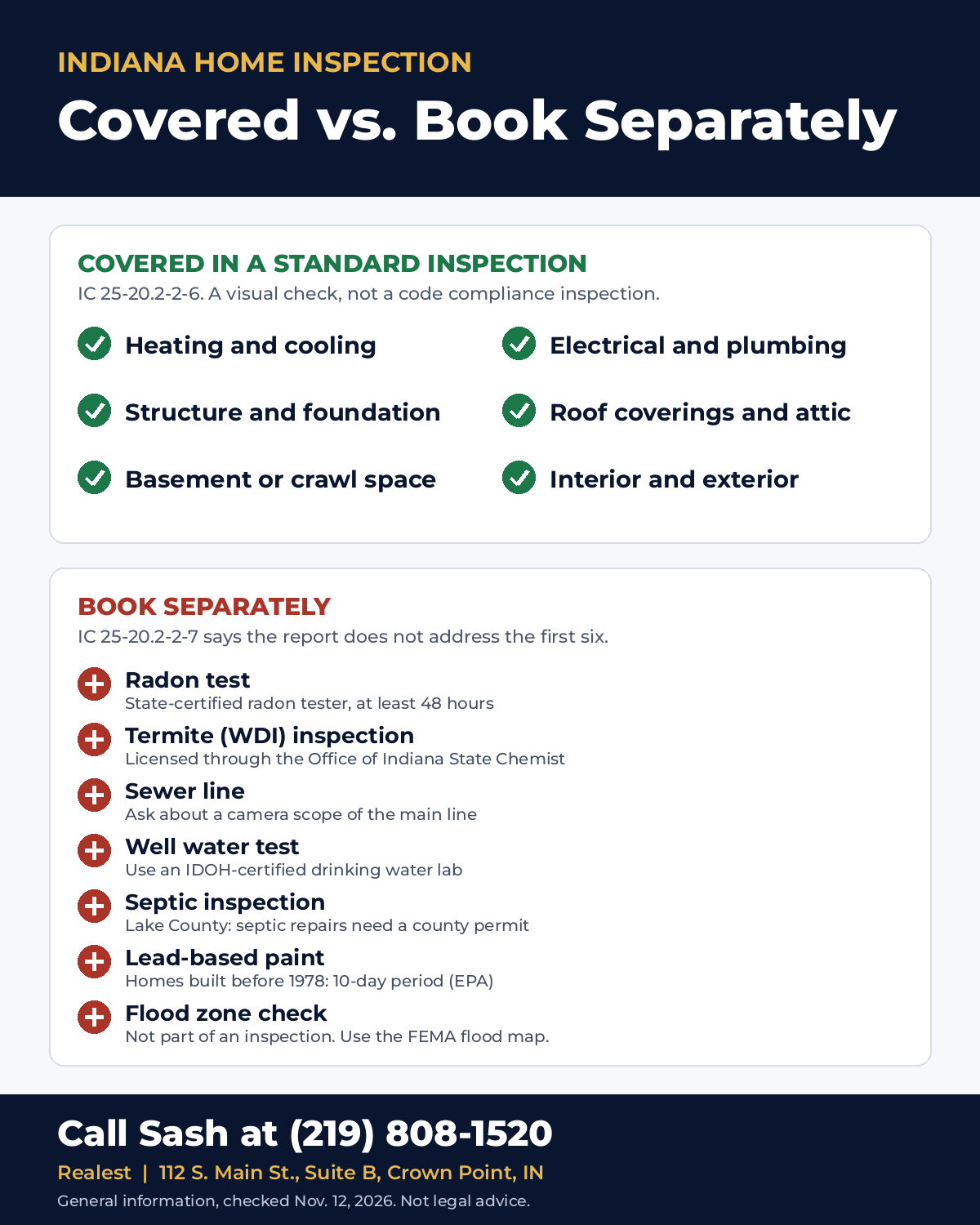
Indiana Code defines a home inspection as a visual analysis that gives a professional opinion on the condition of a home, its garage or carport, the reasonably accessible installed components and the operation of its systems, as set out in IC 25-20.2-2-6. The law lists what that includes:
- Heating and cooling systems
- Electrical and plumbing systems
- Structural components and foundations
- Roof coverings and attic spaces
- The basement or crawl space, if there is one
- Exterior and interior components, plus other site conditions that affect the house
The same section says a home inspection is not a code compliance inspection. The state's minimum standards for home inspections, 878 IAC 1-2-1, add two limits worth knowing before you hire anyone. An inspection under those standards is not technically exhaustive, and it will not find concealed conditions or latent defects. The standards apply to buildings with five or fewer dwelling units.
What the report has to tell you it leaves out
Under IC 25-20.2-2-7, an Indiana home inspection report must flag systems the inspector thinks are significantly deficient or near the end of their service life, with a recommendation to fix or monitor each one. It must also list anything the standards call for that wasn't inspected, and why. Then it has to include three statements. The report does not address:
- Environmental hazards, including lead-based paint, radon, asbestos, mold, mercury, carbon monoxide, pesticides, treated lumber, rodents and cockroaches.
- Wood-destroying insects and organisms, such as termites.
- Underground systems, including sewage disposal, water supply and fuel storage or delivery. That covers sewer lines, septic systems, wells and buried fuel tanks.
The state standards also say inspectors are not required to judge code compliance, market value or whether you should buy the house. They don't have to offer engineering services, inspect detached structures other than garages and carports, or inspect condo common areas. They also don't have to move furniture, personal property, snow or ice. In a Northwest Indiana winter, that last point matters. If snow covers the roof, expect the report to say so, and ask your inspector how they'll handle it.
Add-on inspections Northwest Indiana buyers often book
Which extras make sense depends on the house. A newer home on city sewer and water needs a different list than an older farmhouse on a well and septic. Here is where each one stands under state and county guidance.
Radon test
The Indiana Department of Health says radon testing isn't required in a real estate sale, but it's highly recommended. A buyer can ask for a radon test as part of the inspection, and the department recommends a licensed radon professional when you want an unbiased third party. Real estate tests run for at least 48 hours under closed-house conditions, per the department's radon brochure. Indiana requires anyone who tests or mitigates radon in someone else's home to be state-certified. The department posts its certified radon professionals list. Our realest.net guide to radon testing in Lake and Porter counties goes deeper.
Termite and wood-destroying insect inspection
In Indiana, wood-destroying insect (WDI) inspectors are certified and licensed through the Office of Indiana State Chemist. They look for termites, carpenter ants, carpenter bees, powderpost beetles, other wood-boring beetles and signs of wood decay fungus. A WDI inspector can't apply pesticides without a separate applicator license, so the inspection and any treatment are separate jobs.
Sewer line
Because the report doesn't address sewage disposal, the line from the house to the street isn't part of a standard inspection. On an older home, ask your inspector or a sewer contractor about a camera scope of the main line before your inspection period ends.
Well water and septic
Porter County's health department notes that most homes inside town or city limits are on a water utility. Homes outside that service can run on a private well and septic. The Indiana Department of Health says private wells aren't regulated by IDEM or the EPA, so the owner is responsible for the water. The Lake County Health Department says to contact its Environmental Division at (219) 755-3655 when water testing is required for a sale. It also says any septic repair or change needs a county permit before the work is installed. The Porter County Health Department says it doesn't require well testing when a home changes hands, though it recommends testing and notes that some mortgage lenders require it. Our realest.net guide to well and septic inspections in Lake and Porter counties covers the steps.
Lead-based paint in homes built before 1978
For most homes built before 1978, federal rules give buyers a 10-day period to have a lead-based paint inspection or risk assessment done. The buyer and seller can agree in writing to lengthen or shorten that period, and the buyer can waive it, according to the EPA's lead disclosure rule page.
Flood zone
A home inspection won't tell you whether a property sits in a mapped flood zone. Look the address up on the FEMA Flood Map Service Center before you write an offer. Our realest.net guide to flood zones in Lake and Porter counties shows how.
How to check a home inspector before you hire one
Indiana requires a license to do a home inspection for pay, unless an exemption in the law applies, under IC 25-20.2-5-1. To get licensed, an inspector has to complete approved training, pass an exam and show general liability coverage of at least $100,000. The report itself has to show the inspector's name and Indiana license number, per 878 IAC 1-2-1. You can look up any license for free on the Indiana Professional Licensing Agency's Search and Verify tool.
The law also protects your report. Under IC 25-20.2-8-1, the state licensing board can discipline an inspector who shares your results without your approval, outside a court order. The board can also discipline an inspector who takes pay for repair work recommended in their own report, or a commission from someone else who does that work. If an inspector offers to fix what they found, that's a reason to ask more questions.
After the report: how we help you respond
Your purchase agreement sets the inspection period and the deadline to respond, so read the dates in your signed agreement the day it's accepted. Book any add-on tests right away. For well water, the lab tells you how long results take. When the report comes back, we sort the findings into safety issues, big-ticket items and routine maintenance. Then we help you decide what to ask the seller for under the terms of your agreement. Real Estate USA's guide to the home inspection contingency in Northwest Indiana walks through that window, and our post on why home sales fall apart covers what to avoid.
Read the seller's disclosure next to the report. Indiana law says the disclosure form isn't a warranty and can't be used as a substitute for an inspection, under IC 32-21-5-9. If you get a disclosure or an amended disclosure after your offer is accepted and it reveals a defect, IC 32-21-5-13 gives you two business days to cancel the contract in writing and get your deposits back. Our guide to the Indiana seller's disclosure form explains what sellers have to tell you, and our realest.net page on Northwest Indiana inspection flags lists what tends to come up here.
Indiana home inspection questions
What does a home inspection cover in Indiana?
Under IC 25-20.2-2-6, it is a visual analysis of the home's heating, cooling, electrical and plumbing systems, structure and foundation, roof coverings, attic, basement or crawl space, interior and exterior components, garage or carport and site conditions that affect the house. It is not a code compliance inspection.
Does an Indiana home inspection include radon or mold testing?
No. Under IC 25-20.2-2-7, the report must state that it does not address environmental hazards, including radon, mold, lead-based paint and asbestos. Book a radon test with a state-certified radon professional, and ask about other testing if you have concerns.
Does a home inspector check the septic system, well or sewer line?
Not in a standard inspection. Indiana law requires the report to state that it does not address underground systems such as sewage disposal, water supply and fuel storage. Arrange a well water test, septic inspection or sewer line scope separately.
Do home inspectors need a license in Indiana?
Yes. Under IC 25-20.2-5-1, a person may not do a home inspection for pay without an Indiana home inspector license, unless an exemption applies. You can verify a license for free with the Indiana Professional Licensing Agency.
Is the seller's disclosure a substitute for a home inspection?
No. Under IC 32-21-5-9, the Indiana seller's disclosure form is not a warranty and may not be used as a substitute for any inspection the buyer later gets.
Can my home inspector also do the repairs?
It's best to use someone else. Under IC 25-20.2-8-1, the state licensing board can discipline an inspector who takes pay for repair work recommended in their own report. Use a separate contractor for repairs and estimates.
Buying in Northwest Indiana? Start with Realest
Realest is based in Crown Point and helps buyers across Northwest Indiana and Chicagoland. We'll help you plan the inspection period, decide which add-on tests fit the house and respond to the report on time.
Call Sash at (219) 808-1520, email saso@realest.com or Contact Realest
Realest112 S. Main St., Suite B
Crown Point, IN 46307
Love Thy Neighbor.
General information, checked November 12, 2026, not legal advice. Laws, county procedures and contract forms can change, so confirm the details for your purchase agreement and the exact property. We don't recommend specific inspectors or quote inspection prices.
Categories
- All Blogs (107)
- buyers (7)
- Buying (1)
- commercial (2)
- Community & Lifestyle (25)
- first time buyers (12)
- Home Buying Tips (13)
- Home Selling (4)
- homebuyers (12)
- Homeownership & Maintenance (4)
- Join Realest (5)
- Listings (16)
- Local Market Insights (18)
- real estate (12)
- real estate agent (14)
- Real Estate Investing (2)
- Real Estate News & Trends (5)
- sellers (6)
- selling (3)
Recent Posts